

L'Aquila
Above: Santa Maria di Collemaggio
On our 2005 trip we visited L'Aquila and found it to be a very interesting town that was easy to walk about and explore. There is a very rich history. We were glad that we did not put off our visit for another time as it was in 2009 when an earthquake destroyed many of the treasures of the town.
Eathquakes are part of the history of this town. It was back in December 1315 when an eathquake damaged the San Franesco Church. Then, again in 1349 about 800 people died from that earthquake. Other serious quakes were in 1452. 1461. 1501, 1646 and 1703. As a result of the 1703 quake over 3,000 people perished. If that was not enough, again in 1786 6,000 died, in 1958 another hit the town.
In terms of the 2009 quake, restoration work is underway and we look forward to going back at one point.
L'Aquila is 100 km north-east of Rome. The autostrade runs through the mountain range and driving up to L'Aquila is relatively easy. Taking a train is another option if your are not up for the drive.
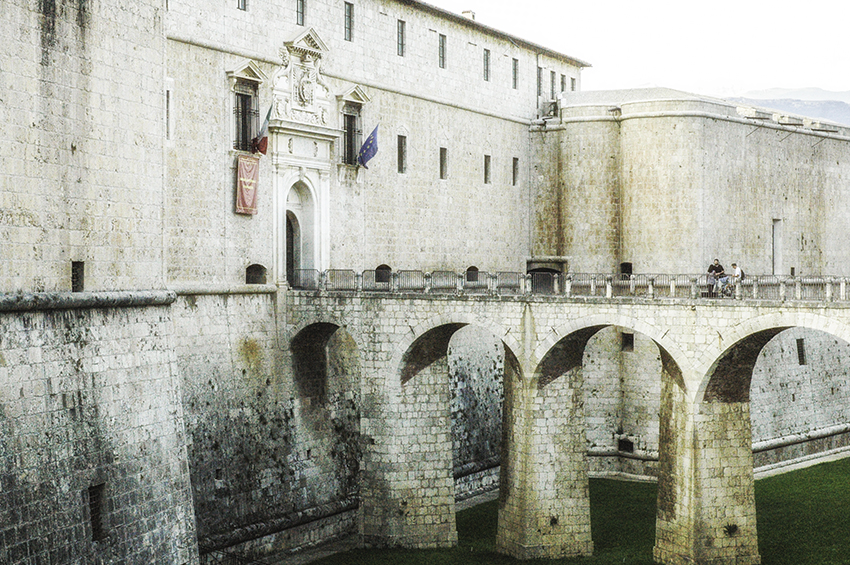
Above: Forte Spagnolo, a Renaissance castle in L'Aquila.
Emperor Frederick II established L'Aquila in 1240 as a means of protecting his holdings from the Popes. To create L'Aquila he brought together people from 99 different villages. So there is a theme — 99. At one time there were 99 churches, 99 piazzas etc. He built, and it still remains, a fountain with 99 spouts - one to represent each of the 99 villages. Most of the churches and piazzas were destroyed by earthquakes but the Fontana delle 99 Cannelle is still there, and according to the tour books, the town hall bell chimes 99 times every evening, but I must admit I don't remember actually hearing that many chimes.
The advantage of keeping good friends paid off, as since the town was loyal to Queen Giovanna II, after a long drawn out attack in 1423, the Queen thanked the city by granting L'Aquila a range of privileges that made it the second ranking city, in what was then the Kingdom of Naples.
Plan to see the Basilica Santa Maria di Collemaggio (pictured at the top of the page). The white and pink tone tile work will just visually hit you when you walk down the long road that takes you to the grounds in front of the church. The Basilica has an interesting history. A hermit, Pietro da Marrone, was elected Pope, and at the age of 80 in 1294 he started the building of the Basilica. He took the name Pope Celestine V. He was, however, no match for the crafty politicians of the day and he was forced to abdicate. Pope Boniface VIII took over and viewed Celestine as a threat. Celestine was placed in prison until he died. His tombs lies inside the basilica.
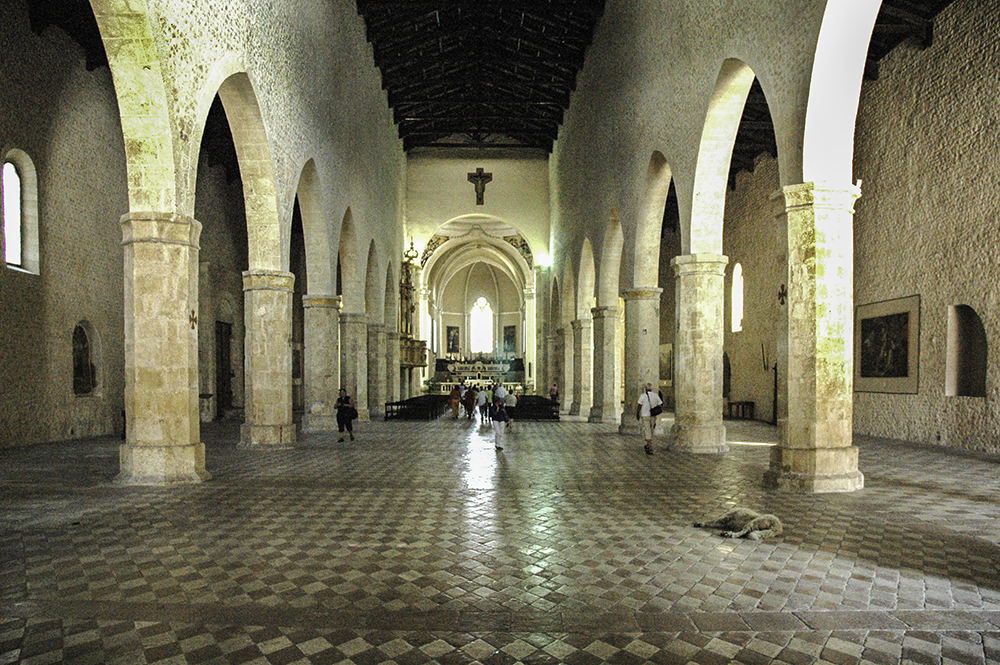 While the exterior of the basilica is stunning the interior is very plain. The previously rich interior haa been stripped. Of course I found the old dog lying on the floor a visual point of interest! The tomb of Celestine V is the main decoration left inside the Collemaggio. Also visit the cloisters which are accessible from the exterior of the church.
The Forte Spagnolo is one of the largest structures in L'Aquila. It houses the Museo Nazionale d'Abruzzo. In the 15th Century L'Aquuila, was the second most powerful city in the Kingdom of Naples. At the time Spain ruled the city and they built this castle. It cost alot, the taxes became so high L'Aquila begged for the construction to stop. It did. Parts of the castle were never completed.
Make time to view the museum. An interesting, easy to take collection is well worth your time. Kind of out of the theme of the majority of the works, there is the skeleton of a mammoth found near the town in the early 1950's.
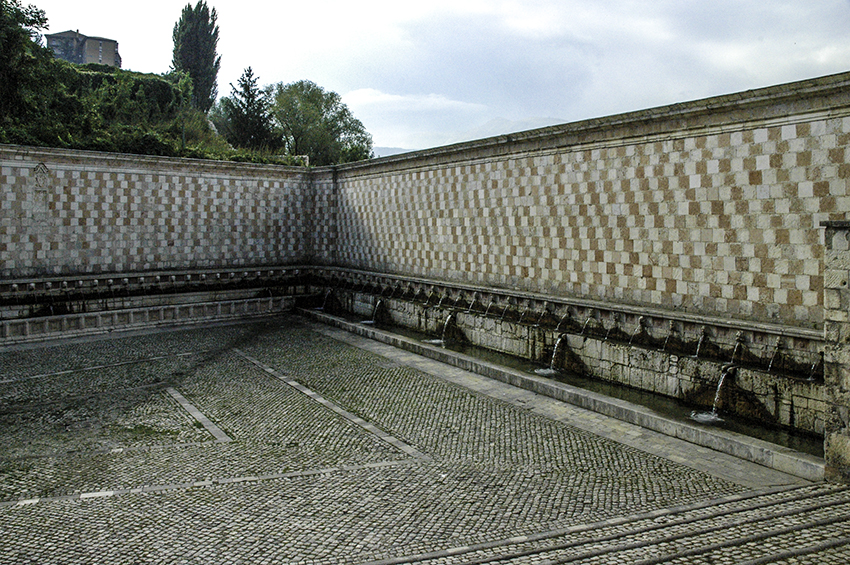
We walked over to see the Fontanna Delle 99 Cannelle located well out of the centre of town so plan enough time, about a 20 minute walk and be prepared to go down, and back up, a hill. Do it in the morning before your feet are tired! This being the last sight of the day was a little hard!
 The fountain of 99 spouts luckily was not damages in the 2009 earthquake - yet the neighbourhood in which it stands was totally destroyed.
It was built in 1272, desitgned by architec Tancredi da Pentima. You can count the heads, I did not, but reports indicate there are only 93 heads and six regular spouts. They all add up 99. It is impressive and considering the age it is a sight that is worth the walk. The 99? Well there were 99 castles that joined to found the city, and supposedly, this is the water from each of them. Major structural work took place between 1582 and 1585. Evidently, it was at this time that 66 new spouts were added to being the structure in line with this legend.
Of the 99 spouts, 93 are in the mouths of grotesque masks, each differnt from each other.
The fountain was used as a washshed.
The original power of L'Aquila was based the relationship between L'Aquila the other villages. Each established the city as a federation, each building a borough and being part of the larger overall village. The fountain was named to celebrate the origin of the town.
We stayed at a hotel across from the Piazza Duomo, and this is a great location for walking about the city. The market takes place in the Piazza and the set up and take down is all part of the event.
When you walk from the Piazza Duomo and take Corso Vittorio Emanuele you will arrive at the Quattro Cantoni, the four corners, the city's main cross road.
Go to the left on Corso Umberto and arrive at the Piazza del Palazzo, and it has the Palazzo di Giustizi. The bell in the palace's town sounds 99 strokes every day at dusk.
If you leave the Quattro Cantoni along via San Bernardino you will find yourself at the San Bernardino, a masterpiece of architecture.